



ADGM Foundations
Updated: July 2026
1. ADGM Foundations in one line
A foundation in ADGM is a separate legal person (not a relationship like a trust) that can own assets, contract, and hold shares in its own name—designed for long-term ownership, governance, and succession.
2. Recent updates (2023–2025) are “operational”, not a rewrite
ADGM hasn’t reinvented the regime; it has tightened administration and enforcement in practice—especially around CSP accountability, filings, notices, and predictable strike-off workflow.
3. CSP accountability was sharpened (2023)
For Non-Exempt Foundations, the Company Service Provider is now clearly positioned as the party responsible for registrar notices and filings, reducing ambiguity when compliance deadlines are missed.
4. Record-keeping expectations became tougher (2023)
ADGM introduced explicit post-strike-off retention: key accounting records should be kept for years after dissolution, with liability attaching to “persons in default” if records are improperly destroyed.
5. Strike-off and dissolution became more structured (2025)
The Registrar’s enforcement sequence is now more “procedural”: inquiry triggers, fixed response windows, and notice/publication steps make outcomes more predictable for families and administrators.
6. Fees + rule cross-references were modernised (2025)
ADGM moved away from fixed schedules and instead uses Board-made rules for fees and updated cross-references to newer commercial licensing / naming / administrative instruments, aligning foundations with ADGM’s broader framework.
7. Why ADGM is picked for serious structuring
The draw is less marketing and more mechanics: English common law applied directly, ADGM Courts, a deepening ecosystem of funds/asset managers, and growing market familiarity—helpful for banks, lenders, and counterparties.
8. Where foundations show up in real structures + how 10 Leaves helps
Common use-cases include holding companies/SPVs, real estate title holding (where registries allow), family governance, succession planning, and purpose/charitable endowments (often with a Guardian). 10 Leaves supports the lifecycle end-to-end: CSP setup + registered office + ongoing filings/recordkeeping, while 10 Leaves Legability handles bespoke charter/by-laws, governance design, reserved powers, and cross-border structuring.
Recent updates - 2026
Legislative and Regulatory Enhancements
Across 2023–2025, ADGM has not “rewritten” its Foundations regime, but it has tightened how foundations are administered, filed, and enforced in practice—mainly by (i) sharpening the Company Service Provider’s role, (ii) strengthening record-keeping expectations, (iii) modernising the strike-off process, and (iv) updating cross-references to ADGM’s newer commercial framework.
1) Clearer filing responsibility for CSPs (2023 amendment)
A key change in 2023 was making it explicit that—save for a limited exception—the Company Service Provider of a Non-Exempt Foundation is responsible for giving notices and making filings the foundation must make to the Registrar (including under the Foundations Regulations, relevant commercial licensing rules, and the Beneficial Ownership and Control Regulations). This aligns administration with how ADGM foundations are typically operated in real life (through CSPs), and reduces “grey areas” about who is accountable when filings are missed.
2) Post strike-off record retention (2023 amendment)
ADGM also introduced a practical governance safeguard: accounting records must not be destroyed for 5 years after a foundation is struck off, and non-compliance is expressly framed as a contravention, with liability attaching to councillors in default. This matters for audits, disputes, tax authority queries, and bank reviews that often arise after a structure is wound down.
3) Updated strike-off and dissolution mechanics (Amendment No. 1 – 2025)
In 2025, ADGM revised the core strike-off workflow. The Registrar may issue a formal inquiry where there is reasonable cause to believe the foundation is in breach, no longer meets requirements, or is conducting activities that may adversely affect ADGM’s reputation. The process now hard-codes response windows (including 14 days to respond to the inquiry) and a published notice mechanism before strike-off and dissolution. This is a meaningful operational change: it makes the enforcement sequence more structured and predictable for CSPs, councillors, and families.
4) Fees framework moved to “rules made by the Board” (Amendment No. 1 – 2025)
ADGM removed the old “Schedule 1” approach and instead allows the Board to set fees payable to the Registrar via rules, including for Registrar functions and services. This is more flexible and keeps fees aligned to the broader ADGM commercial framework as it evolves.
5) Family-group establishment linkage to Companies Regulations 2020 (Amendment No. 1 – 2025)
A new provision applies Companies Regulations 2020 (subsection 3(5)) where a foundation is established by a group of natural persons who are members of the same family—an example of ADGM aligning foundations practice with its wider company law architecture for real-world family structuring.
6) Modernised legal references + “Fines Scale” alignment (Amendment No. 2 – 2025)
Amendment No. 2 (2025) is mostly technical, but important in compliance terms: it updates references to newer instruments (e.g., Commercial Licensing Regulations 2025, Business and Company Names Rules 2025, and the Administrative Regulations 2025), and standardises penalty language as “not exceeding level X on the Fines Scale,” tied to the Administrative Regulations’ schedule.
7) Service of documents via registered email (Amendment No. 2 – 2025)
A practical upgrade: ADGM expressly permits certain notices to be served via the foundation’s registered email (or the CSP’s registered email), which reflects how Registrar communications actually happen and reduces process friction.
Why set up a Foundation in the ADGM?
The Abu Dhabi Global Market has, over the past few years, moved from being an emerging centre to a jurisdiction that is routinely used for serious holding and structuring work. That shift is reflected in the numbers, but more importantly, in how ADGM is now used in practice.
By the end of 2024, ADGM hosted 2,381 operational entities, representing year-on-year growth of just over 30%. This was not limited to regulated financial firms. A significant portion of that expansion came from holding companies, investment vehicles, and SPVs established to sit within wider ownership, financing, and fund structures. The momentum continued into 2025. By mid-year, ADGM reported 11,128 active licences, with 1,869 new licences issued in the first half alone, and by Q3 2025 the total had increased further to 11,920 active licences. At that point, ADGM had become the largest international financial centre in the MENA region by licence count.
For Foundations, scale matters. A jurisdiction with several thousand live vehicles tends to be better understood by banks, counterparties, and regulators than one that is still niche. ADGM has now reached that level of critical mass.
Access to capital is the second pillar. Abu Dhabi is one of the few places globally where sovereign and state-backed investors operate at truly vast scale, deploying trillions across markets worldwide. As those institutions have increased their footprint in ADGM, the centre’s asset and fund-management community has accelerated sharply. In 2024, ADGM reported roughly 245% growth in assets under management, and by mid-2025 it hosted 154 asset and fund managers running 209 funds spanning private equity, private credit, infrastructure, and other alternative strategies.
Underneath that momentum is a legal system built for predictability. ADGM applies English common law directly and sits on its own court infrastructure, backed by an independent regulator. In foundation planning, that translates into something very specific: dependable treatment of ownership, security packages, enforcement pathways, and governance—exactly the areas where international investors and lenders expect clarity.
Alongside institutional growth, Abu Dhabi has seen a steady increase in high-net-worth and ultra-high-net-worth individuals establishing a base in the emirate. Long-term residency programmes, political stability, and a clear focus on inter-generational planning have contributed to this trend. As a result, ADGM is now commonly used for family offices, private investment platforms, and legacy-planning foundations where longevity and governance are prioritised over short-term optimisation.
By Q3 2025, ADGM’s professional community had grown to approximately 39,870 professionals, reflecting the depth of legal, financial, and advisory talent now operating within the centre. Combined with Abu Dhabi’s broader infrastructure and quality-of-life offering, this has reinforced ADGM’s position as a jurisdiction chosen for durability rather than convenience.
What are ADGM Foundations?
ADGM Foundations sit within the Abu Dhabi Global Market as standalone legal persons, created to hold assets and administer long-term ownership arrangements within a common-law framework. Once established, the foundation exists independently of the individual who set it up. Assets transferred into it are no longer personal property; they belong to the foundation itself.
The comparison with trusts comes up often, but it only goes so far. A trust is not an entity. It depends on trustees, fiduciary duties, and the ongoing exercise of discretion by individuals. A foundation does not. It owns property outright, contracts in its own name, and continues to exist regardless of changes in personal circumstances. There is no split between legal and beneficial titles, and no need for third parties to look “through” the structure to understand who owns what.
Banks, registries, and counterparties tend to engage more easily with an entity than with an arrangement. Ownership is visible, authority is clearly vested in a governing body, and continuity does not depend on the replacement of officeholders. Over time, this tends to reduce operational friction, particularly where assets are held across borders or where long-term financing, security, or enforcement considerations are involved.
ADGM Foundations appear most often where families or principals want a durable ownership platform that can outlast individual lifetimes. Common applications include succession planning, consolidation of operating businesses, long-term holding of investment assets, family office arrangements, and purpose-based or philanthropic structures. The attraction is not novelty; it is stability.
The regime allows founders to shape governance without turning the structure into a personal extension of themselves. Control can be retained, delegated, or staged over time through council composition, reserved powers, and oversight roles. These mechanics are embedded in constitutional documents rather than informal understandings, which makes them easier to defend, enforce, and explain to third parties years down the line.
For internationally mobile families, this combination of legal personality, institutional governance, and common-law certainty is often the deciding factor. An ADGM Foundation provides a fixed legal anchor around which assets, advisers, and jurisdictions can change, without requiring the structure itself to be rebuilt each time circumstances evolve.

What are the benefits of setting up a Foundation in the ADGM?

Asset Protection
Assets held in a personal name tend to sit on the front line. If a claim is brought, whether by a creditor, a counterparty, or through a family dispute, personal ownership is usually the first place attention turns. An ADGM Foundation alters that starting point in a fundamental way.
Once assets are settled into the foundation, ownership shifts entirely. The individual no longer owns the property; the foundation does. From a legal perspective, that matters. Claims against the founder do not automatically translate into claims against assets that are no longer theirs. The separation is structural, not cosmetic, and it is recognised under ADGM law because the foundation exists as a legal person in its own right.
That said, the framework is not designed to be abusive. It does not override insolvency principles or legitimise improper transfers. Transactions remain open to challenge where there is evidence of fraud, sham arrangements, or attempts to put assets beyond the reach of existing creditors. Used properly, however, and as part of forward-looking planning, the foundation provides a defensible and orderly way to separate personal risk from long-term asset ownership.
Privacy and Confidentiality
ADGM Foundations are registered entities - the public record confirms the existence of the foundation, not the details of how it is run. Information about founders, beneficiaries, and internal governance arrangements is maintained privately rather than published on open registers. Personal names do not appear on the ownership records of assets held through the foundation.
For many families, that reduced visibility is not about secrecy; it is about proportionality. A lower public profile can help limit unwanted attention, reduce the risk of speculative claims, and avoid drawing unnecessary links between individuals and valuable assets. Importantly, this operates within the boundaries of ADGM’s compliance, AML, and beneficial ownership framework, rather than outside it.
Tax and Cross-Border Planning
Families with internationally distributed assets and family members are often subject to overlapping tax, inheritance, and succession regimes. An ADGM Foundation does not, by itself, remove tax exposure. Instead, it functions as a structuring tool that can support more orderly ownership, clearer asset holding, and smoother inter-generational transitions across borders.
Used correctly, the foundation provides a stable legal anchor around which tax advice in relevant jurisdictions can be implemented. This is particularly valuable where assets are spread across multiple countries, or where family members have different tax residencies.
Succession and Inter-Generational Planning
An ADGM Foundation allows a founder to put in place clear and enforceable rules governing how assets are managed, controlled, and ultimately applied for the benefit of others. These rules can operate both during the founder’s lifetime and after death, reducing reliance on wills alone and limiting the scope for fragmentation or dispute.
Because the foundation itself continues to exist regardless of changes in personal circumstances, it provides continuity that individual ownership structures cannot. This makes ADGM Foundations especially effective for families seeking long-term stability, predictable governance, and structured wealth transfer across generations.
What are the specific advantages of setting up a Foundation in the ADGM?

Independent common law legal system
The Abu Dhabi Global Market operates under a legal framework that applies English common law directly, as it stands from time to time. Civil and commercial matters are determined by the ADGM Courts, with proceedings conducted in English. This provides a high level of legal certainty and familiarity for international families, advisors, lenders, and counterparties, particularly in cross-border structuring and dispute scenarios.
Separate legal personality
An ADGM Foundation is a legal person in its own right. It can hold assets, enter into contracts, and assume rights and obligations directly, without the need for trustees or nominee ownership arrangements. This clear separation between the foundation and the individuals connected to it underpins many of its governance and asset-protection benefits.
Wide asset-holding capability
An ADGM Foundation may hold a broad range of assets, both within the UAE and internationally. In practice, this often includes shares in operating or holding companies, bank and custody accounts, investment portfolios, real estate (where permitted), intellectual property, and other legally permissible assets. The regime is asset-neutral and does not restrict foundations to specific categories of property.
Flexible governance
Governance arrangements are not locked in permanently at the point of establishment. The ADGM framework allows founders to design bespoke governance mechanisms at inception and to adapt them over time. This includes changes to council composition, oversight roles, reserved powers, and succession mechanics as family dynamics, asset profiles, or commercial realities evolve.
Continuation and re-domiciliation flexibility
ADGM supports the continuation of foreign foundations into the jurisdiction and, where required, the migration of ADGM Foundations out. This flexibility allows families to consolidate legacy offshore structures into ADGM or adapt their arrangements in response to changes in residence, regulation, or long-term planning objectives.
Low capital threshold
An ADGM Foundation can be incorporated with a nominal initial endowment. Significant assets do not need to be transferred at the point of formation, allowing the structure to be established first and funded progressively as planning decisions are finalised.
No physical office requirement
There is no requirement for a Foundation to lease premises in ADGM. The registered office requirement can be satisfied through an appointed ADGM-licensed Company Service Provider, keeping the structure efficient and cost-effective.
No UAE residency requirement
Founders, councillors, guardians, and beneficiaries are not required to be resident in the UAE. This makes ADGM Foundations particularly suitable for internationally based families and globally diversified asset-holding structures.
Flexible appointments
All foundation roles may be held by individuals or corporate entities, including professional service providers. This allows families to prioritise experience, independence, and continuity in governance rather than geographic location.
Limited public disclosure
Only limited information is available on the public register. Details relating to founders, beneficiaries, and the foundation’s assets are not publicly disclosed, supporting a degree of confidentiality while remaining compliant with applicable transparency and beneficial ownership requirements.
Light ongoing administration
ADGM Foundations are not required to publicly file annual accounts or audited financial statements, provided they do not carry on regulated activities. That said, proper records must be maintained, and ongoing obligations relating to AML, beneficial ownership, and regulatory filings continue to apply.
Can I hold property in the name of an ADGM Foundation?

An ADGM Foundation is a legal person in its own right. As a matter of ADGM law, there is nothing that prevents a foundation from owning real estate directly in its own name. As with any structure, the decisive factor is not ADGM law itself, but whether the land registry and applicable local rules in the jurisdiction where the property is located permit a foundation to be registered as the legal owner.
Within Abu Dhabi, this has become increasingly workable in practice. Since ADGM’s jurisdiction was extended to Al Reem Island, ADGM entities — including foundations — are now more commonly accepted as title-holding vehicles for property on the island, subject to the policies of the relevant developer and land registry requirements. As real estate registration on Al Reem has moved more squarely under ADGM’s ecosystem, the use of ADGM Foundations for property holding has shifted from being unusual to being a recognised structuring option.
In Dubai, the position is also feasible but tends to be more procedural. ADGM Foundations may hold property in designated freehold areas, subject to the rules of the Dubai Land Department and, in some cases, additional requirements imposed by developers. In practice, the issues that arise are rarely legal prohibitions. They are more often related to documentation, confirmations around beneficial ownership, and internal comfort levels within the registry or developer. Some transfers proceed smoothly, while others require additional structuring or clarifications to satisfy these requirements.
Outside the UAE, ADGM Foundations are commonly used in real estate structures without significant difficulty. Where local law permits foreign legal entities to own property, the foundation can either hold title directly or sit above a local property-holding company, depending on tax, regulatory, or financing considerations in that jurisdiction.
What an ADGM Foundation should not do is carry on an active real estate business. Passive ownership of property is permissible. Receiving rental income is generally permissible. However, activities such as property development, tenant management, or operating as a landlord in an active commercial sense typically need to be carried out through a properly licensed operating entity. In many structures, those activities are housed in a subsidiary company owned by the foundation, leaving the foundation itself as a holding and governance vehicle.
From a structuring perspective, holding UAE or GCC property through an ADGM Foundation can also be helpful when demonstrating regional substance and connection. Ownership of assets located in the region is a recognised and commercially coherent way of anchoring the structure to the UAE, which can be relevant when eligibility, banking, or ongoing compliance considerations are reviewed.
Can an ADGM Foundation be a shareholder in other companies?

Yes, Foundations can be the direct shareholders of companies set up in the larger free zones in the UAE, such as JAFZA and the DMCC. Other free zones are also beginning to accept Foundations as shareholders in companies.
What is the process to set up a Foundation in the ADGM?
Setting up a Foundation in the ADGM involves the following steps:
1. Collation of documents – This includes detailed KYC of the Founder(s), Council members, Beneficiaries and Guardian (if applicable) of the Foundation.
2. Preparation of resolutions and legal documents – Preparation of the Charter, By-Laws and incorporation documents of the Foundation. While the Charter & By- Laws can be standard templates, we recommend customization given the specific requirements of each client.
3. Finalisation of Registered Address –Will be provided by 10 Leaves Limited as a CSP.
4. Initial submission to the ADGM Registration Authority
5. ADGM Review - Standard Timeline is five to seven business days for ADGM to review the application and revert.
6. Final Approvals – the Foundation is now formed!
7. Bank account opening is not mandatory, but recommended.

What is the legal system that is followed in the ADGM?
For civil and commercial matters, the Abu Dhabi Global Market operates under a legal system that sits outside the UAE’s onshore court structure. ADGM applies English common law directly, as a body of law in its own right, rather than adapting or borrowing selectively from it. This framework exists alongside the UAE’s federal civil law system, not within it.
Disputes connected to ADGM are heard by the ADGM Courts, which conduct proceedings in English and apply ADGM legislation together with established common law principles. From the outset, this model was designed to be familiar to international parties dealing with complex commercial arrangements, financing transactions, and cross-border structures.
The ADGM Courts have been operating since ADGM’s establishment in 2015 and are institutionally separate from the Abu Dhabi onshore courts. Their jurisdiction covers disputes involving ADGM-incorporated entities, contracts governed by ADGM law, and matters arising within ADGM’s regulatory and commercial perimeter. In practice, this creates a self-contained judicial environment for structures established in the centre.
A distinguishing feature of ADGM is that it applies English common law as it develops over time, subject to any modifications introduced by ADGM legislation. This approach allows ADGM jurisprudence to evolve in step with developments in English law, rather than remaining fixed at a particular point. For lenders, investors, and advisers, that continuity reduces uncertainty around how principles such as contractual interpretation, security, and enforcement are likely to be treated.In transactional practice,
ADGM Courts are frequently chosen as the dispute resolution forum for regional and international structures involving holding companies, funds, and financing vehicles. The attraction is largely practical: clear procedures, predictable reasoning, and judgments that integrate smoothly with both the UAE enforcement framework and international recognition mechanisms.
What are the differences in the legal structures of an ADGM Foundation and a Trust?

ADGM Foundation
An ADGM Foundation is constituted as a legal person under the Abu Dhabi Global Market’s foundations framework. Although it shares the feature of legal personality with a company, it is not a commercial vehicle and does not operate on corporate profit-distribution logic.
Because the foundation exists in its own right, it is able to hold assets, assume rights and obligations, and contract directly with third parties. Assets transferred into the structure—whether shares, bank accounts, real estate (where permitted), or other property—are owned by the foundation itself. They do not remain vested in the founder, the council members, or the beneficiaries.
The foundation may bring legal proceedings or be subject to them in its own name. There is no need for office holders to act as claimants or defendants on its behalf. Both legal and beneficial ownership of the assets sit with the foundation, subject to the framework set out in its Charter and By-laws, which define purpose, governance, and the manner in which benefits may be applied.
Control and oversight are exercised institutionally. The Council is responsible for administration and decision-making, broadly comparable to a board. Where appropriate, a Guardian may be appointed to supervise compliance with the foundation’s objects, particularly in purpose or charitable structures. The defining feature is that governance and ownership are embedded within the foundation as an institution, rather than resting with individuals.
Trust (under ADGM Trust Law)
A trust established under ADGM law operates on a different legal footing. It is not an entity. Instead, it is a legal relationship governed by English trust principles, centred on trustees and fiduciary obligations.
In a trust arrangement, trustees hold legal title to the trust assets. They are the parties that contract with banks and counterparties and that initiate or defend legal proceedings. Because the trust itself has no legal personality, it cannot act independently. All dealings are undertaken by the trustees in their representative capacity.
Beneficial ownership lies with the beneficiaries, or, in the case of discretionary trusts, is exercised through the trustees’ discretionary powers. The distinction between legal ownership (with trustees) and beneficial ownership (with beneficiaries) is fundamental to trust law. Where disputes arise, proceedings are brought by or against the trustees personally, albeit acting as trustees, rather than in the name of the trust.
Practical distinction in structuring
From a structuring perspective, ADGM Foundations are often favoured where direct asset ownership, long-term continuity, and straightforward interaction with third parties are important. Because the foundation owns assets and contracts in its own name, it can simplify banking, enforcement, and succession planning, particularly where structures are intended to endure across generations.
Trusts, by contrast, are typically selected where fiduciary discretion is intended to play a central role. They remain highly effective where flexibility, trustee judgment, and discretionary benefit are core objectives, but they can introduce additional layers of complexity in contracting, enforcement, and long-term administration.
In practice, the choice between an ADGM Foundation and a trust turns on how governance is intended to function, the nature of the assets involved, and the degree of control or discretion that is appropriate over time.
Parties to an ADGM Foundation

The Founder is the individual or body corporate that brings in the assets to the ADGM Foundation. The Founder usually retains certain powers as per the provisions of the Law, the Charter and the By-Laws of the Foundation.
How can a Founder keep and exercise control on the Foundation and it’s assets?
The following control mechanisms may be included in the Charter and By-Laws:
- Appointment and removal of Council Members and/or the Guardian;
- Appointment of the Founder as a Council Member with casting vote rights;
- Veto rights over specific matters (as Guardian);
- Reserved powers to amend the Charter and By-Laws, including dissolution of the Foundation.
Council Member
Similar to the Director of a company under Common Law, the Council Members of an ADGM Foundation govern it’s operations and administration in accordance with the Foundation Charter and By-Laws. The members of the council may include the Founder and a corporate body, such as a company service provider.
Guardian
In ADGM, the Guardian oversees the Foundation and its Council as a supervisory body. While a Founder is alive, appointing a Guardian is optional and depends on the Charter and By‑laws. Once there is no surviving Founder, a Guardian must be appointed. The Guardian must be independent of the Founder and Council (and cannot be the sole Beneficiary), reflecting ADGM’s emphasis on a clear separation between governance and oversight.
Beneficiaries
The beneficiaries are the individuals or corporate bodies who have been nominated to benefit from the assets held within the ADGM Foundation. They would have to be named in the documents of the Foundation and the Founder can be the sole beneficiary or one of the beneficiaries of the Foundation.
Does an ADGM Foundation require a Registered Agent or a Company Service Provider?
An ADGM Foundation is required to have a registered office address within the Abu Dhabi Global Market. This address is used for statutory records, official correspondence, and service of notices.
In practice, an ADGM Foundation cannot simply lease office space in its own name in the way an operating company would. Foundations are not intended to have operational substance or physical premises, and ADGM does not expect — or encourage — foundations to maintain standalone offices.
Accordingly, the registered office requirement is typically satisfied by appointment of an ADGM-licensed Company Service Provider (CSP) such as 10 Leaves.
What is a Registered Agent/ Company Service Provider for an ADGM Foundation?
A Company Service Provider (CSP) for an ADGM Foundation is an entity licensed by the ADGM Registration Authority (RA) to provide corporate, foundation, and administrative services within ADGM.
ADGM Company Service Providers are not licensed by the FSRA. Instead, they are authorised directly by the ADGM Registration Authority and act as the statutory interface between the Foundation and ADGM.
For an ADGM Foundation, the CSP effectively functions as the registered agent, providing both the registered office and ongoing administrative support.
Typical services provided by an ADGM CSP include:
1. Foundation setup and incorporation
Managing the end-to-end incorporation process with the ADGM Registration Authority, including name reservation and formation filings.
2. Preparation and filing of constitutional documents
Drafting, customising, and filing the Foundation Charter and By-laws in line with ADGM Foundations Regulations and the founder’s structuring objectives.
3. Provision of registered office address
Supplying the mandatory ADGM registered office address for the Foundation and acting as the official address for service of notices and correspondence.
4. Ongoing administration and secretarial support
Maintaining statutory records, handling filings and updates with the Registration Authority, and supporting changes to council members, guardians, or governing documents.
5. Governance support
Assisting with council resolutions, governance documentation, and practical implementation of the Foundation’s decision-making framework.
6. Compliance and AML coordination
Supporting the Foundation’s compliance with applicable AML, beneficial ownership, and transparency requirements, including liaison with banks and counterparties where required.
Accounting and bookkeeping services may be offered by some CSPs, but this is not a mandatory function and depends on how the Foundation is structured and whether it holds assets that generate reportable transactions.
Are there any naming requirements?
The name of an ADGM Foundation must end with the word ‘Foundation’. It should also comply with the naming rules that are in force at the ADGM.
What is the Foundation Charter? What does it need to contain?
The Foundation Charter is the primary constitutional document of an ADGM Foundation. It is the instrument by which the foundation is legally established and sets out its core identity, purpose, and high-level governance framework.
The Charter is filed with the ADGM Registration Authority as part of the registration application. It is not published. Only limited information appears on the public Foundations Register - the Foundation's name and registration number, its Company Service Provider, its Councillors and its date of establishment. The Charter itself sets out the core constitutional details which include the Founder's details, the objects, the initial assets and the Designee. The Foundation's detailed governance mechanics, control provisions and beneficiary arrangements sit in the By-laws, which are not filed with the Registrar at all. Beneficiary details form part of the Confidential Disclosure, which the Registrar is required to hold confidentially.
The Charter must comply with the mandatory requirements prescribed under the ADGM Foundations Regulations and is designed to confirm the legal validity of the foundation without disclosing commercially or personally sensitive details.
In practice, the Charter:
- evidences the lawful establishment of the foundation under ADGM law;
- identifies the nature of the foundation (beneficiary, purpose, or hybrid);
- sets out the foundation’s core objects and structural framework; and
- anchors the governance architecture that is then elaborated in the By-laws.
The By-laws operate alongside the Charter as a private document and typically contain the substantive rules governing administration, reserved powers, council and guardian roles, beneficiary rights or discretions, and succession mechanics. Together, the Charter and By-laws define how the foundation operates during its lifetime and how it will be administered or wound up, while preserving confidentiality where appropriate.
Mandatory contents of the Foundation Charter
The Charter must state:
- The name of the Foundation.
- The name and address of the Founder, or each of the Founders.
- The objects of the Foundation, including whether it is established for beneficiaries, for purposes, or both.
- Where the Foundation is established for a specific purpose, a clear description of that purpose..
- Provision for the establishment of a Council, including confirmation that the Foundation is to be administered by a Council.
- The name of any Beneficiary, being either a natural person or a legal person, if the Founder chooses to specify one in the Charter.
- The name of a Designee, who must always be specified in the Charter and acts as the fallback beneficiary where no Beneficiaries are named or where all named Beneficiaries cease to exist or cannot take.
- The name and address (within ADGM) of the Registered Agent, where a registered agent is appointed.
- The address of the Foundation’s registered office in ADGM.
- The duration of the Foundation, if it is established for a fixed term, or alternatively the contingent event(s) upon which the Foundation is to be dissolved.
Role of the Charter in practice
The Charter provides the statutory and legal framework of the Foundation, while more detailed governance, operational mechanics, and rights and obligations of the Council, Guardian, Founder, and beneficiaries are typically set out in the By-laws. Together, the Charter and By-laws define how the Foundation operates during its lifetime and how it will be administered or wound up.
How can I use a Foundation for restructuring and legacy planning?
Foundations, like trusts, are primarily used for structuring and legacy planning. A typical structure is as below:

ADGM Foundations are commonly used to reorganise existing asset holdings and to put long-term succession and legacy plans in place, particularly where wealth is spread across multiple jurisdictions or asset classes.
In a typical arrangement, the Founder transfers selected assets into the Foundation. From that point onward, the assets are owned by the Foundation itself, which operates as an independent legal entity. The Foundation is run by its Council, whose role is to manage and supervise the structure in line with the terms set out in the Charter and By-laws.
A Guardian may also be appointed to provide oversight or to exercise specific reserved powers. While a Founder is alive, ADGM law does not require a Guardian unless the Charter or By-laws say so,
and many founders choose to introduce this role as part of their succession planning. It is often designed to take effect on the Founder’s death or loss of capacity, helping preserve continuity and ensuring that the Founder’s intentions continue to be respected over time. Once there is no surviving Founder, a Guardian must be appointed.
Asset consolidation and restructuring
An ADGM Foundation can hold a wide variety of assets, including:
- shares in operating companies or holding entities.
- listed securities, bonds, and managed investment portfolios.
- real estate, either directly or through SPVs where appropriate.
- alternative assets such as private equity, commodities, or other investments.
Assets may be located in the UAE or overseas, allowing founders to bring otherwise fragmented holdings under a single ownership and governance framework.
Legacy and succession planning benefits
By placing assets within a Foundation, founders are able to:
- centralise ownership and decision-making, reducing reliance on multiple wills or nominee structures.
- ensure continuity in the event of death or incapacity, without triggering probate or ownership break-up.
- set out clear rules for how assets are managed and how benefits are to be provided, through the Foundation’s governing documents.
Any distributions or benefits are made to the named beneficiaries strictly in accordance with the Founder’s instructions, whether those benefits are fixed, discretionary, or subject to conditions. Crucially, beneficiaries do not own the underlying assets. Legal ownership remains with the Foundation at all times.
Perpetual existence
Unlike individuals or many corporate arrangements, an ADGM Foundation may be established for an unlimited duration (subject to its Charter). This allows the structure to continue across generations, making it particularly effective for dynastic wealth planning, family business ownership, and long-term stewardship of assets.
Can ADGM Foundations be used for charitable activities?
ADGM Foundations cannot be set up with exclusively charitable objects under the basic regime, but they can still be used to support philanthropic and public‑interest goals as part of a broader, lawful purpose. In practice, this means an ADGM Foundation is usually drafted with wealth‑management, succession or asset‑holding purposes, and charitable giving is built into that framework rather than being its sole objective.
ADGM guidance and practitioner commentary confirm that foundations are commonly used as endowment or grant‑making vehicles. The foundation can hold and invest capital over time and then make distributions to recognised charities or public‑benefit projects, provided it stays within UAE laws on fundraising, public donations and regulated charitable operations. The foundation itself is typically not an “operating charity”; instead, it sits behind the scenes as a structured owner of philanthropic capital and a grant‑maker.
Importantly, the fact that a foundation has philanthropic objects does not turn it into a pure charitable foundation under ADGM law, and the Regulations explicitly exclude “exclusively charitable purposes” as a standalone foundation object. Where long‑term charitable missions are central, founders often use hybrid models – for example, an ADGM foundation holding an endowment and a separate charity or non‑profit vehicle that carries out regulated on‑the‑ground activities.
Oversight in these cases still follows the standard ADGM rules: a Guardian is optional while at least one Founder is alive, and becomes mandatory once there is no surviving Founder. The Guardian cannot be the Founder, a Councillor or the sole Beneficiary, and its role is to monitor the Council and ensure decisions stay aligned with the foundation’s stated objectives – which is particularly useful where philanthropic or public‑interest purposes form part of those objects.
What can an ADGM Foundation NOT do?

While ADGM Foundations are powerful tools for wealth structuring, succession, and governance, they are not universal solutions and should not be misunderstood or misused. Understanding their limitations is essential to ensuring that a foundation is structured correctly and remains legally robust.
1. Not a regulated asset management vehicle
An ADGM Foundation is not authorised to carry out regulated financial services activities such as discretionary asset management, investment advisory, or fund management. Where active investment management is required, this is typically undertaken through licensed managers or underlying regulated entities. Such entities can manage the assets of an ADGM Foundation, in effect, the Foundation becomes a client of the regulated asset manager, which is permissible.
2. Not a vehicle for active commercial trading
Foundations are intended primarily as holding and governance entities. Where a foundation directly conducts trading, financing, or service activities, this may trigger regulatory, corporate tax, or licensing implications. In practice, operating activities are usually housed in subsidiary companies or SPVs, not at the foundation level.
3. Not a means to defeat existing creditor claims
ADGM firewall and asset-protection provisions do not protect assets transferred into a foundation with the intent to defraud creditors or where the founder was insolvent at the time of transfer. Foundations are effective for forward-looking planning, not for shielding assets from existing or foreseeable claims.
4. Not an automatic override of forced-heirship rules
While ADGM law provides strong protection for the internal validity and administration of foundations, it does not eliminate the risk of challenge where a structure is improperly implemented, inadequately funded, or inconsistent with public policy.
5. Not a tax shelter by default
An ADGM Foundation does not in itself eliminate tax exposure. Tax outcomes depend on the nature of the assets, income flows, jurisdictions involved, and the tax residency of founders and beneficiaries. Foundations are structuring and governance tools, not tax avoidance vehicles.
6. Not a substitute for proper governance
A foundation is only as effective as its Charter, By-laws, and governance framework. Poorly drafted documents or excessive founder control can undermine both asset-protection and succession objectives. Do book a slot with our legal team to get assistance on bespoke governance documents for the foundation.
Can the ownership of existing operational business be transferred into the ADGM Foundation, without any disruptions?
Yes, the transfer of the shareholding of existing companies within the UAE and the GCC is a simple process. In essence, it is a share transfer in the operational entity. There are some free zones in the UAE that currently do not recognise ADGM Foundations - in these cases, we have worked with ADGM SPVs to hold such assets and the shares of the SPV are in turn held by the ADGM Foundation.
Can I open a bank account for an ADGM Foundation?
While ADGM Foundations are widely accepted by financial institutions, bank account opening is a substantive process and should be planned for early in the structuring phase. Banks assess foundations more rigorously than standard companies due to their role in wealth holding and succession planning.
In practice, ADGM Foundations can open bank accounts in the UAE and internationally, but approval depends on a clear understanding of the structure, the source of wealth, and the governance framework.
Key points banks typically assess
1. Source of wealth and asset provenance
Banks will require detailed documentation explaining how the Founder acquired the assets contributed to the Foundation. This includes historical records, transaction trails, and supporting evidence for significant asset transfers.
2. Governance and control mechanics
Particular focus is placed on:
Reserved powers retained by the Founder
The role and independence of the Council and Guardian
Succession mechanics following the Founder’s death or incapacity
3. Excessive founder control may result in enhanced scrutiny or requests for structural adjustments.
4. Purpose and activity profile
Banks expect ADGM Foundations to operate as passive holding or governance entities. Operating cash flows, trading activity, or third-party transactions are typically expected to occur at the level of underlying SPVs or operating companies, rather than through the Foundation itself.
5. Beneficiaries and succession clarity
- Clear identification of beneficiaries (or classes of beneficiaries), together with defined distribution mechanics, reduces onboarding friction and future review risk. Practical timing and expectations.
- Bank onboarding for ADGM Foundations typically takes longer than for standard corporate entities, particularly where cross-border assets or UHNW profiles are involved.
- Early alignment between the Foundation’s governing documents and banking expectations can significantly reduce delays.
- In some cases, multiple banking relationships may be used — separating custody, operating accounts, and investment accounts across different institutions.
What are the key differences between DIFC and ADGM Foundations?

Both the DIFC and the ADGM offer mature, common‑law based foundation regimes that are internationally recognised and widely used for private wealth, succession and long‑term asset‑holding structures. The real choice between them is rarely about legal quality; it is about strategic fit – where the family lives, where the assets sit, and which ecosystem the advisers and banks operate in.
Legal system and courts
DIFC operates a common‑law system developed locally, administered by the DIFC Courts, with its own Foundations Law and a growing body of DIFC‑specific precedents. ADGM, by contrast, imports and applies English common law more directly within its framework, so the overall legal “feel” is closer to a UK‑style environment transplanted into Abu Dhabi. Both offer high levels of certainty and international enforceability, and families and advisers typically choose based on familiarity with one system or the other rather than perceived strength or weakness.
Private wealth and family ecosystem
DIFC has built a deep concentration of private banks, family offices, wealth managers and specialist advisers over the last two decades. For families with complex, multi‑asset portfolios and active governance needs – particularly those resident in or around Dubai – this ecosystem makes DIFC foundations a natural fit. ADGM has also grown rapidly, especially around fund and asset‑management platforms and Abu Dhabi‑based institutional capital, and foundations there are often used when the rest of the structure already orbits that environment.
Real estate structuring
DIFC benefits from a well‑established practice, supported by arrangements with the Dubai Land Department, that allows DIFC vehicles (including foundations and SPVs) to hold Dubai real estate in designated areas. For families with significant exposure to Dubai property, this is frequently a deciding factor, as it allows the wealth‑holding and governance spine to sit in DIFC while plugging neatly into Dubai real estate. Abu Dhabi‑centric property structures more naturally look at ADGM foundations, in line with local practice there and the broader Abu Dhabi ecosystem.
Funds and investment structures
Both DIFC and ADGM offer sophisticated fund and asset‑management regimes, and foundations in each centre can be used alongside those structures. In practice, ADGM foundations are often found in setups where the wider architecture – fund vehicles, asset‑management entities and investment committees – is already established in ADGM. DIFC foundations, on the other hand, are typically used as ownership or governance vehicles above investment SPVs or operating companies, especially where those entities are based in DIFC or otherwise integrated into Dubai‑focused business and banking relationships. The choice of foundation jurisdiction in fund‑related structures usually follows where the rest of the platform is already located, rather than driving that decision on its own.
Market practice and familiarity
Both regimes are now well‑understood by advisers and widely used by regional and international families. DIFC foundations are commonly used in structures where the family’s advisers, banks and operating businesses are predominantly Dubai‑centric, including cases where families have relocated to Dubai and wish to align wealth‑holding and governance with their day‑to‑day ecosystem. ADGM foundations are similarly used where the key investment platforms, fund managers or family‑office arrangements are anchored in or around Abu Dhabi, and where it is convenient to keep the foundation within the same regulatory and advisory environment. In most cases, familiarity with the local ecosystem and existing relationships influences the choice more than any technical difference between the two foundation regimes.
Technical and governance distinctions
Beyond ecosystem and geography, there are several structural differences that practitioners should be aware of:
- Guardian eligibility: In DIFC, the Founder or a professional service provider can be appointed as Guardian, subject to the usual conflict‑management safeguards. In ADGM, the Guardian must be independent; the Regulations expressly state that the Guardian cannot be a Founder, a member of the Council, or the sole Beneficiary, which creates a clearer separation between governance and oversight.
- Guardian trigger: Under DIFC law, a Guardian is mandatory where the Foundation has charitable or specified non‑charitable objects, and otherwise optional. Under ADGM law, appointing a Guardian is optional while at least one Founder is alive, but becomes mandatory once there is no surviving Founder, regardless of the Foundation’s objects.
- Reserved powers: DIFC places time‑based limits on certain reserved powers retained by the Founder (commonly framed around lifetime or a fixed period, such as 50 years), to encourage eventual “settling” of control. ADGM does not impose an equivalent statutory cap; the Regulations allow reserved powers to be structured with greater flexibility, subject to general validity and anti‑avoidance principles.
- Initial assets: In DIFC, initial assets can be nominal and there is no hard statutory minimum, allowing very light‑touch initial endowment in some cases. ADGM guidance, by contrast, commonly refers to committing initial assets of at least USD 100 to the Foundation, and stresses that initial assets must be sufficient to meet the Foundation’s purpose.
- Designee and beneficiaries: ADGM requires that every Foundation Charter specify a Designee, who acts as a fallback beneficiary if no other Beneficiaries are named or if all named Beneficiaries cease to exist or cannot take; naming Beneficiaries in the Charter is optional, but the Designee is always required. DIFC does not have an equivalent mandatory Designee concept and allows more flexibility in how and when beneficiaries are identified.
- Corporate service providers: In ADGM, the appointment of an ADGM‑registered Company Service Provider (CSP) is mandatory for non‑exempt foundations, meaning most foundations must work through a CSP for filings and ongoing administration. DIFC foundations do not have an equivalent blanket CSP requirement; founders can work directly with the DIFC registry, although many still choose to engage a professional service provider for practical reasons.
These technical distinctions do not make one regime inherently “better” than the other, but they do influence drafting style, governance architecture and cost profile. In practice, most families and advisers decide between DIFC and ADGM by combining these features with their broader strategic picture: where they are based, where the assets and investment platforms sit, and which legal and advisory ecosystem they are most comfortable operating in.
Does the ADGM Foundations Regime require any kind of local representation at the ADGM?
The ADGM Foundation can use the address of a Company Service Provider such as 10 Leaves – it does not have to lease an office separately.
Does the ADGM have special courts for ADGM Foundations?
The ADGM Courts have jurisdiction over ADGM Foundations, and the Regulations specify a pro-active role for ADGM Courts.
Can the ADGM Foundation be Sharia'-compliant?
The ADGM Foundation can apply Sharia' principles to its governance and consolidation of underlying assets.
Is an ADGM Foundation subject to Corporate Tax in the UAE?
Corporate Tax in the UAE is applied by reference to substance. The question is not where an entity is formed, or what label it carries, but whether it is carrying on a business and generating taxable income.
An ADGM Foundation has a separate legal personality, so it is not excluded from the Corporate Tax regime as a matter of principle. That said, foundations are rarely used in a way that gives rise to taxable profits in their own hands. In most structures, the foundation sits above the assets rather than operating them.
Where a foundation’s activities are limited to holding shares or assets, exercising ownership rights, and providing a governance or succession framework, it does not typically undertake business activity in the ordinary sense. In those cases, income is earned at the level of operating companies, investment vehicles, or other underlying structures, and not by the foundation itself.
Issues tend to arise only where the foundation moves beyond a passive role. Direct lending, fee-earning arrangements, active investment operations, or the provision of services can all change the analysis. If those features are present, the foundation’s position would need to be reviewed against the Corporate Tax rules in the same way as any other legal person.
As with most tax questions in this area, the outcome turns on how the structure functions in practice rather than how it is described on paper.
A few key points to consider
1. No automatic exemption.
2. An ADGM Foundation is not automatically excluded from Corporate Tax simply because it is established in the ADGM. Its tax position must always be assessed by reference to its activities and income profile.
3. Passive foundations are typically outside the charge.
Foundations that only hold shares or assets, receive dividends or capital distributions, and do not conduct commercial or trading activities, are generally not regarded as carrying on a taxable business.
4. Tax applies if business activity is conducted.
An ADGM Foundation may become subject to Corporate Tax if it directly carries on a commercial or investment business, earns operating income or management fees, or performs active financing, lending, or service functions.
In such cases, Corporate Tax would apply at the prevailing rate on taxable profits.
1. Free zone status is not determinative
While the Foundation is established in a free zone, it does not automatically qualify as a Qualifying Free Zone Person. Most foundations do not seek or require such status, as they are not intended to earn taxable income.
2. Compliance obligations may still apply
Even where no Corporate Tax is payable, Corporate Tax registration and record-keeping obligations may still need to be assessed, and foundations remain subject to AML, UBO, and governance requirements.
What are the tax residency, reporting and disclosure requirements for an ADGM Foundation?
While ADGM Foundations are commonly used as tax-neutral holding and governance structures, they remain subject to international tax transparency and reporting frameworks. These obligations arise independently of whether Corporate Tax is payable in the UAE.
Tax residency
An ADGM Foundation is generally regarded as UAE-resident for legal and administrative purposes by virtue of its incorporation and registered office in the ADGM. However, tax residency alone does not determine tax liability. Tax exposure depends on:
- the nature of the Foundation’s activities;
- the location of underlying assets and income sources; and
- the tax residence of founders and beneficiaries.
Corporate Tax registration
Even where an ADGM Foundation is structured as a passive holding vehicle and no Corporate Tax is expected to be payable, Corporate Tax registration and filing obligations may still need to be assessed on a case-by-case basis, based on Federal Tax Authority guidance and the Foundation’s activities. Do get in touch with us to know more.
CRS and FATCA reporting
ADGM Foundations are commonly brought within the scope of Common Reporting Standard (CRS) and, where relevant, FATCA, typically through their banking relationships. In practice:
- financial institutions determine reporting classification;
- information relating to controlling persons or beneficiaries may be reportable to relevant tax authorities; and
- confidentiality under ADGM law does not override international reporting obligations.
Beneficiary-level taxation
Distributions from an ADGM Foundation may give rise to tax consequences at the beneficiary level, depending on the beneficiary’s jurisdiction of tax residence and the nature of the distribution. The Foundation itself does not shield beneficiaries from their personal tax obligations.
Record-keeping and disclosures
Regardless of tax liability, ADGM Foundations are expected to maintain appropriate:
- accounting and transaction records;
- governance documentation; and
- compliance filings (including AML and UBO disclosures).
Can an ADGM Foundation be used to hold charitable endowments?
Not automatically. A Foundation cannot conduct its activities in a manner that would make it a non-profit organisation - broadly, one that primarily raises or disburses funds for charitable purposes. An endowment usually falls within that description, so it requires the Registrar's approval on written application.
In simple terms, a charitable endowment involves capital that is permanently set aside to support a cause. The assets are not meant to be returned to the donor, nor distributed for private benefit. Instead, they are preserved, invested, and applied over time in line with a defined objective. ADGM Foundations are well suited to this model because they combine legal ownership, continuity, and purpose-based governance within a single structure.
Under ADGM law, a foundation may be established for a purpose rather than for beneficiaries. Where a foundation is set up in this way, it does not exist to benefit individuals or families. Its role is to hold and manage assets exclusively in pursuit of the purpose set out in its Charter.
In an endowment context, the donor transfers assets to the Foundation and, in doing so, relinquishes both legal and beneficial ownership. From that point onward, the assets belong to the Foundation itself. They may be invested, preserved, or applied in accordance with the Charter, but they are no longer part of the donor’s estate and cannot be reclaimed. This separation is fundamental to how endowments function and is expressly accommodated by the ADGM framework.
Because there are no beneficiaries to enforce the purpose, a Guardian is strongly recommended. A Guardian must in any event be appointed once there is no surviving Founder.
The Guardian’s role is not ceremonial. It exists to ensure that the Council administers the Foundation strictly in line with its charitable purpose. In practice, the Guardian becomes the enforcement mechanism for the endowment, providing oversight and accountability where no private beneficiary exists.
It is important to distinguish between holding charitable capital and conducting charitable operations. An ADGM Foundation can hold and deploy endowment assets, but it does not replace the wider UAE regulatory framework governing charities, fundraising, or public donations. Most ADGM charitable foundations therefore operate as funding or grant-making vehicles. They support recognised charities or approved initiatives rather than running public-facing programmes themselves.
The legal expression of a charitable endowment in ADGM sits primarily in the Foundation Charter, supported by detailed By-laws. Together, these documents record:
- the purpose of the endowment,
- how assets may be invested and applied,
- any limits on spending or distributions, and
- the governance checks designed to preserve the endowment over time.
Can a Foundation apply for residence visas and work permits?
No, an ADGM Foundation cannot have any employees or apply for residency or work permits.
Do I need to be physically present to apply for the ADGM Foundation?
No, the ADGM client on-boarding system is fully digital and the process is done online. 10 Leaves will assist you throughout this process.
How much does it cost to setup a Foundation in the ADGM?
The ADGM fees are as follows:
Year 1
1. Name Reservation - US$ 200
2. Registration Fees - US$ 300
3. Data Protection - US$ 300
4. Commercial License - US$ 200
Year 2 onwards
1. License Fee - US$ 200
2. Data Protection Annual Renewal - US$ 300
Foundation Charter, Council agreements etc.). Do contact us for a customised quote!
How Can 10 Leaves help you?
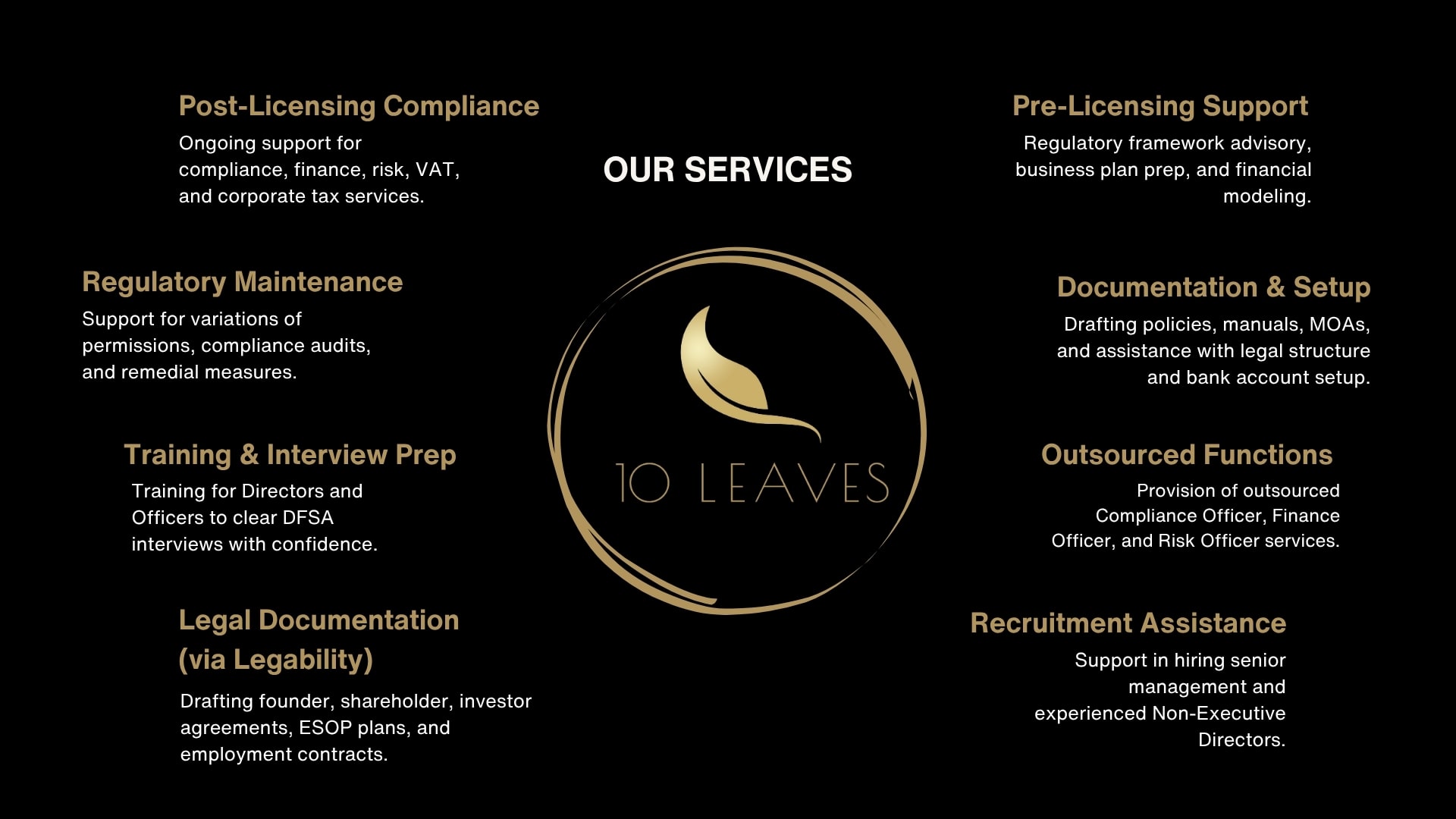
10 Leaves and 10 Leaves Legability operate in a coordinated but clearly separated model to support the establishment, structuring, and ongoing operation of ADGM Foundations. This separation reflects both regulatory expectations and best practice, ensuring that Company Services, administration, and legal structuring are each delivered within the appropriate professional remit.
Role of 10 Leaves (Company Service Provider)
10 Leaves is an ADGM-licensed Company Service Provider (CSP). Its role is focused on the formal establishment, administration, and ongoing regulatory interface of ADGM Foundations. This ensures that foundations are properly constituted under ADGM law, correctly maintained on the register, and remain in good standing throughout their lifecycle.
Services provided by 10 Leaves include:
- incorporation and registration of ADGM Foundations, including eligibility assessment and coordination with the ADGM Registration Authority;
- provision of the registered office address, as required under the ADGM Foundations framework;
- maintenance of statutory registers and foundation records;
- company secretarial and administrative support, including renewals and ongoing filings;
- KYC onboarding and ongoing record maintenance in line with ADGM requirements; and
- acting as the primary point of contact with the Registration Authority on administrative and compliance matters.
This CSP function anchors the foundation within the ADGM legal framework and ensures operational continuity.
Role of 10 Leaves Legability (Legal structuring and advisory)
10 Leaves Legability is the legal structuring and advisory arm of the group. It operates independently from the CSP function and focuses on the legal architecture and substantive design of ADGM Foundations.
Legability’s role typically covers:
- structuring advice on the use of ADGM Foundations for succession planning, asset holding, family governance, philanthropic or purpose-based arrangements;
- drafting and customisation of Foundation Charters and By-laws to reflect the Founder’s objectives, common-law principles, and ADGM statutory requirements;
- advice on governance mechanics, including reserved powers, council and guardian roles, and succession triggers;
- analysis of control, enforcement, and risk considerations, particularly for purpose or charitable foundations; and
- coordination with external legal, tax, and regulatory advisers in other jurisdictions where the structure has cross-border elements.
Get in touch! to know more about ADGM Foundations










 CONTACT