



Re-domiciliation of a Special Purpose Vehicle to the DIFC
Updated: August 2026
The DIFC Prescribed Company Regulations 2026, in force on 24 July 2026, remove the eligibility tests — qualifying purpose, UAE/GCC nexus — that used to limit who could set up a PC in the DIFC. Access is now open to any person or entity globally, with oversight moved from the front-door eligibility gate to mandatory use of DIFC-licensed Corporate Service Providers for non-exempt controllers, and enhanced compliance responsibilities sitting at CSP level. That change matters just as much for companies already incorporated elsewhere as it does for new incorporations — because it also makes redomiciling an existing SPV into the DIFC considerably more straightforward than it used to be.
As international businesses continue to expand across jurisdictions, many corporate groups seek a stable, internationally recognised financial centre to hold investments, manage assets, and streamline corporate structures. The DIFC offers an attractive solution through its continuation (re-domiciliation) regime, allowing eligible foreign companies to transfer their domicile to the DIFC without creating a new legal entity.
For businesses operating through a Special Purpose Vehicle (SPV), re-domiciliation to the DIFC provides access to a world-class legal framework, enhanced corporate governance, and a strategic gateway to regional and global markets, while preserving the company's legal identity and business continuity.
What is Re-domiciliation?
Re-domiciliation, also referred to as continuation, is the legal process by which a company changes its jurisdiction of incorporation while remaining the same legal entity.
Unlike a liquidation followed by incorporation of a new company, re-domiciliation enables the company to continue its existence without interruption. Contracts, bank relationships, litigation history and asset ownership carry over — the entity's legal identity doesn't reset, only its domicile changes.
This makes re-domiciliation an efficient option for businesses seeking to relocate their corporate domicile without disrupting operations.
Why Choose the DIFC for Your SPV?
The DIFC stands as a premier financial centre in the region, hosting over 400 wealth and asset management firms that collectively manage more than $750 billion in assets. This strategic location provides unparalleled access to the extensive private and sovereign capital available in the region.
The DIFC also offers an advanced regulatory framework for digital assets, encompassing investment and crypto tokens, and features a dedicated Innovation Hub supporting companies in the fintech, AI, and blockchain sectors.
Dubai continues to see a notable and sustained influx of High-Net-Worth Individuals (HNWIs). The city is home to over 72,500 HNWIs and Ultra-High-Net-Worth Individuals (UHNWIs), whose combined wealth exceeds $500 billion. The broader Middle East region holds over $3.5 trillion in HNWI wealth and more than $4.8 trillion in financial capital managed by 40 state-owned investors.
The DIFC is also seeing strong growth in the alternatives segment, now home to 75 hedge funds, 48 of which manage over a billion dollars each — the DIFC's own "billion-dollar club." That places the Centre among the world's top ten hedge fund hubs, with an explicit ambition to reach the top five.
Family businesses have been a consistent growth area for the Centre too: family-owned businesses at DIFC grew from roughly 600 to over 800 during 2024, a rise of around 33%. By the end of that year, DIFC reported that the top 120 families and wealthy individuals in its community were managing more than USD 1.2 trillion in wealth, and the use of Foundations and associated structures rose by over 50%, reaching 671 by year-end.
The Centre is also a cultural hub in its own right, featuring fine dining, retailers, and art galleries. Events like DIFC Art Nights and the Sculpture Park attract artists and enthusiasts, and Art Dubai, backed by DIFC, remains the foremost global art event in the Middle East.
Specific Advantages
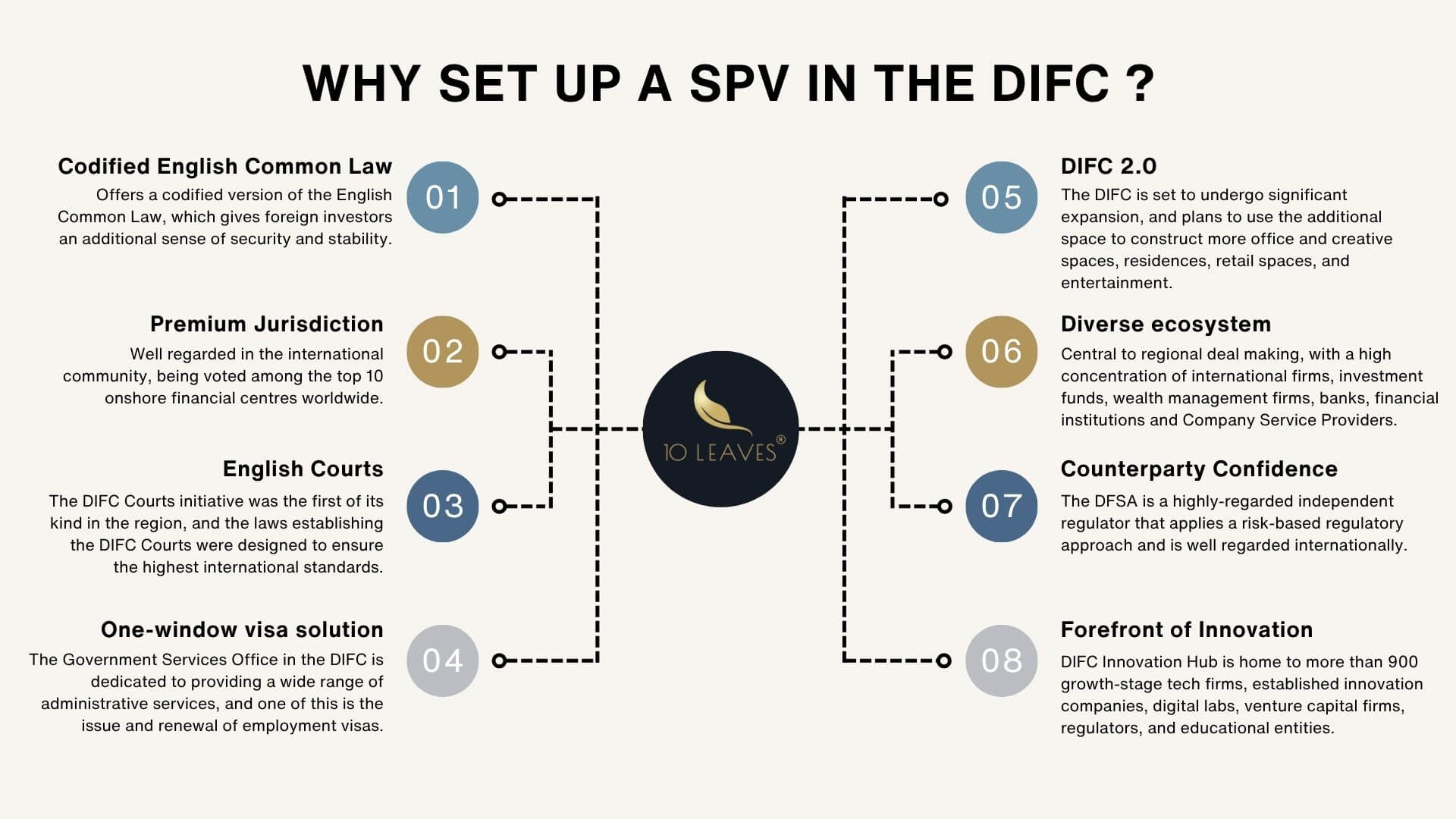
Legal and Regulatory Framework
- Legal framework supports cross-border activities.
- 100% foreign ownership permitted.
- No restriction on foreign talent or employees.
- No restrictions on capital repatriation.
Tax Benefits
- 0% corporate tax, subject to certain qualifications.
- Zero tax on employee income.
Counterparty Confidence
- Highly regarded, independent regulator.
- Independent, English-speaking, common law judicial system.
- Distinct from the wider UAE legal system.
- Risk-based regulatory approach.
Diverse Ecosystem
- Central to regional deal-making.
- High concentration of international firms, investment funds, wealth management firms, banks, and financial institutions.
- World-class regional and international law and auditing firms, and other professional services.
- The largest fund domicile in the region.
Geographic Epicentre
- Management offices, holding companies and family offices sit closer to the assets they own or manage.
- The Middle East, Africa and South Asia (MEASA) region is increasingly the centre of gravity for the global economy.
- Dubai plays a central role in growing South-South trade, principally between Asia and Africa.
- Well-positioned to harness the potential of emerging markets.
Where Are Businesses Typically Redomiciling From?
The clients asking about re-domiciliation are rarely doing so out of the blue. Most are moving away from a structure that made sense five or ten years ago and has since become a source of friction — usually with a bank, an investor, or an auditor.
BVI and Cayman structures are the most common source. Both remain legitimate, but economic substance rules, expanded reporting obligations and more aggressive bank compliance checks have made the ongoing administration of a pure offshore holding company noticeably heavier than it used to be, and banks increasingly ask harder questions about structures domiciled there with no operating rationale. Jersey and Guernsey companies move for broadly similar reasons. RAK ICC and other UAE-adjacent registries sometimes redomicile into DIFC specifically to pick up the institutional signalling and court system that a lighter-touch registry doesn't carry.
In every case, the DIFC's proposition is the same: keep the entity, its history and its contracts intact, and move the domicile to a common-law, court-backed centre with lower ongoing friction than where it currently sits.
Can a Foreign SPV Redomicile to the DIFC?
Yes. Subject to meeting the applicable legal requirements, an SPV incorporated outside the UAE may apply to continue into the DIFC.
To qualify, the company should generally satisfy the following conditions:
- The laws of its existing jurisdiction permit outward continuation. This varies by jurisdiction — BVI, Cayman, Jersey, Guernsey and most other common-law offshore centres generally do, but this should always be confirmed with counsel in the originating jurisdiction before relying on it.
- Shareholders approve the re-domiciliation.
- The company is solvent.
- The company satisfies the eligibility requirements for registration as a DIFC SPV.
- All applicable due diligence and compliance requirements are fulfilled.
The last of these conditions is where the 2026 reforms make the most practical difference. Previously, a redomiciling company had to satisfy the same GCC nexus or Qualifying Purpose test as a new incorporation — so a foreign SPV with no GCC connection and no aviation, maritime, IP, crowdfunding or structured financing purpose simply could not redomicile into a SPV at all. From 24 July 2026, that test no longer applies to the destination vehicle. Any foreign SPV can now redomicile into a DIFC SPV as a passive holding structure, provided it appoints a CSP unless it qualifies as Exempt.
The DIFC Registrar of Companies will review each application on its merits.
Key Considerations Before Redomiciling
Before commencing the continuation process, businesses should consider:
- Whether their existing jurisdiction allows outward continuation, and what that jurisdiction requires in parallel — some registries require a formal deregistration or strike-off application to run alongside the DIFC continuation application, rather than automatically afterward.
- Tax implications in both jurisdictions, including any exit tax or deemed disposal rules in the originating jurisdiction.
- Regulatory approvals that may be required, particularly where the SPV holds regulated assets or sits beneath a regulated fund or manager.
- Banking relationships and notification requirements — most banks require formal notice of a change in domicile, and some will re-run KYC as though onboarding a new client.
- Any ongoing litigation or insolvency proceedings, since these typically need to be disclosed and may affect eligibility.
Obtaining legal and tax advice in both the originating jurisdiction and the DIFC is strongly recommended before starting the process.
The re-domiciliation Process
The continuation process generally involves the following steps:
1. Submit the registration application.
2. Receive the Initial Approval.
3. Payment and e-signing of constitutional documents.
4. Obtain the Licence and Certificate of Continuation.
Mandatory Appointment of a CSP
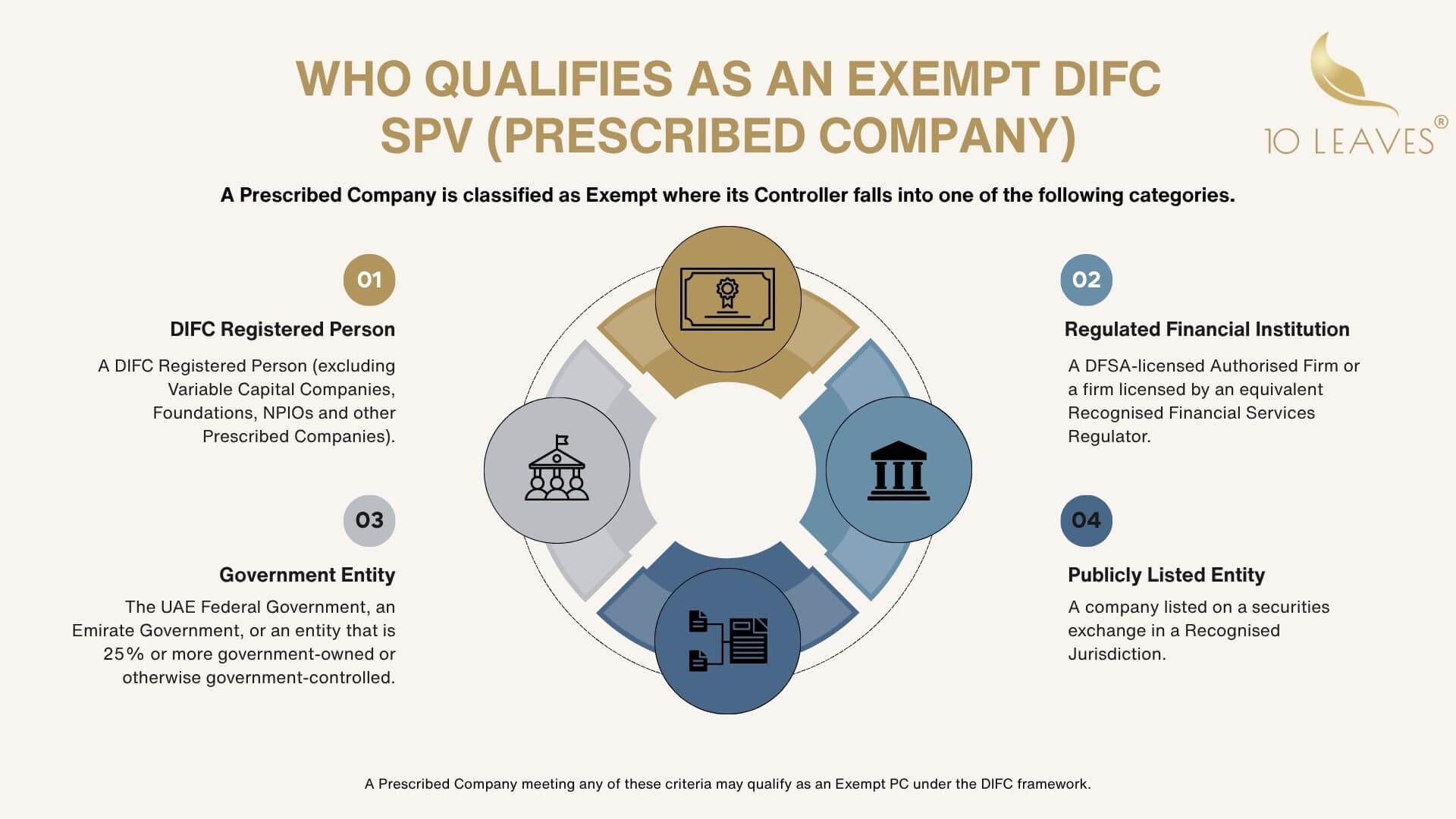
Where a PC was incorporated prior to the Enactment Date of the new regime (24 July 2026) and is not an Exempt PC, the PC must appoint a Corporate Service Provider within six months of the Enactment Date — by 24 January 2027, or such extension as may or may not be approved by the Registrar. This applies equally to a PC that redomiciled into the DIFC before that date.
A PC is Exempt where its Controller is any of the following:
(a) a Registered Person;
(b) an Authorised Firm;
(c) a Government Entity; or
(d) a Publicly Listed Entity.
Registered Office
The registered office shall be either:
(a) in the case of an Exempt PC, that of an Affiliate; or
(b) the registered office of the appointed Corporate Service Provider.
Applicable Fees
For continuation of a company from an outside jurisdiction into the DIFC, the following fee applies:
|
Action |
Fee (USD) |
|
Application to continue incorporation of a Prescribed Company in the DIFC |
1,000 |
|
Knowledge and Innovation Fees |
5.45 |
This is a one-time fee for the continuation itself. Once redomiciled, the PC carries the same ongoing costs as any other DIFC SPV — an annual commercial licence fee of US$1,005.45, an annual Confirmation Statement filing fee of US$300, plus CSP professional fees, which are mandatory (not optional) for non-Exempt PCs under the 2026 regime.
Certificate of Continuation
Once the Registrar approves the application, it will issue a Certificate of Continuation, register the company, and enter its name on the Public Register.
Rights and Liabilities
Where a Foreign Company is continued as a company under DIFC law, the company:
- continues to have all the property, rights and privileges, and remains subject to all the liabilities, restrictions and debts it had before the continuation; and
- remains a party to any legal proceedings commenced in any jurisdiction in which it was a party before the continuation.
In short, re-domiciliation changes the entity's domicile, not its legal history.
Activity
The licence of a DIFC SPV is restricted to the activity of a holding company. A redomiciled SPV takes on this restriction on continuation into the DIFC — if the originating entity was doing anything beyond passive holding, that activity needs to stop, or the re-domiciliation needs to target a different DIFC vehicle (such as an Active Enterprise) instead of a SPV.
How Can 10 Leaves Help You?
10 Leaves is a DIFC-registered Corporate Service Provider at the DIFC, administering a portfolio of over 1,000 entities across DIFC and ADGM. We advise on the full re-domiciliation process — assessing outward continuation eligibility in the originating jurisdiction, coordinating with local counsel where needed, preparing the DIFC application and constitutional documents, and acting as your appointed CSP on an ongoing basis once the continuation completes.
If you're weighing whether an existing BVI, Cayman or other offshore SPV should redomicile into the DIFC, get in touch for a structuring conversation.
About the Authors
Rohit Ghai is the Founder of 10 Leaves and Legability. Over two decades, he has advised founders, family offices, and institutional clients on structuring regulated businesses across the UAE — spanning DIFC and ADGM authorisations, SPVs, Foundations, and compliance frameworks. He works directly on mandates, not at arm's length. Connect with Rohit on LinkedIn.
Bishr Shiblaq is Head of Structuring at 10 Leaves and Legability and advises on cross-border wealth structures across DIFC, ADGM, Luxembourg, and Mauritius. He was previously with Arendt & Medernach, Luxembourg.
Are you looking to redomicile an SPV into the DIFC? Contact us today!










 CONTACT