



DIFC Licensing Categories
Article Overview
1. Prudential reform 2025: DFSA has simplified capital rules – most Category 3 and 4 firms that do not hold Client Assets, Client Money, Insurance Monies or EMPS assets no longer calculate EBCM and instead just maintain Liquid Assets equal to their Base Capital Requirement.
2. Category 4 capital: The Base Capital Requirement for a standard Category 4 firm is US$ 30,000, while higher-risk activities such as Operating a Crowdfunding Platform or Providing Money Transmission require US$ 140,000.
3. Where assets are held: For firms that do hold client or scheme assets/monies, the EBCM still applies, but DFSA has simplified and lowered the multipliers, making calculations more predictable and aligned with audited expenses.
4. Next phase – July 2026: A second wave of reform will introduce Activity-Based Capital Requirements (ABCR), so capital will also reflect the type and scale of activities, bringing DIFC prudentials closer to global standards.
5. Why DIFC: DIFC is a top-10 onshore financial centre, bridging the time-zone gap between London/New York and Hong Kong/Tokyo, with a common-law framework, independent regulator, and tax efficiencies.
6. Depth of ecosystem: The Centre hosts 400+ wealth and asset managers, 70+ hedge funds, 850+ family businesses, ~700 foundations, and a growing HNWI/UHNW community managing US$ 1.2 trillion+ in wealth.
7. Regulatory & legal structure: DIFC Authority oversees non-regulated business; DFSA regulates financial/ancillary services, SFOs and DNFBPs; DIFC Courts and the Arbitration Centre provide an independent, English-language common-law dispute forum.
8. Licence categories & capital stack: Activities (not labels) define the licence category (Cat 1–5); capital is determined as the highest of base, risk-based and any applicable EBCM, with DFSA expecting firms to maintain capital and liquidity appropriate to their nature, size, complexity and risk profile.
DIFC Licensing Categories
Prudential updates – 2025
The DFSA introduced several important prudential changes in 2025 that make capital requirements clearer and more proportionate for DIFC firms. The biggest shift is that most Category 3 and Category 4 firms no longer need to calculate an Expense-Based Capital Minimum (EBCM), as long as they do not hold Client Assets, Client Money, Insurance Monies or EMPS assets. Instead, these firms simply need to maintain Liquid Assets equal to their Base Capital Requirement. Under the updated rules, the Base Capital Requirement for a standard Category 4 firm is US$ 30,000, while certain activities—such as Operating a Crowdfunding Platform or Providing Money Transmission—continue to require US$ 140,000.A second phase of reforms will follow in July 2026, introducing Activity-Based Capital Requirements, where capital will also take into account the type and scale of activities performed. This will bring the DIFC prudential framework closer to global standards, while keeping it proportionate for non-bank financial firms.
DIFC is one of the world’s top ten onshore financial centers and offers a secure and efficient platform for businesses and financial institutions to reach into and out of the emerging markets of the region. The quality and independence of DIFC’s regulator, the prevailing common law framework, excellent infrastructure and tax efficiencies make it the perfect base to take advantage of the rapidly growing demand for financial and business services in the MENASA region.
DIFC fills the time-zone gap for a global financial centre between the leading financial centres of London and New York in the West and Hong Kong and Tokyo in the East.
Why should you set up a financial services entity in the DIFC?

The DIFC stands as a premier financial center in the region, hosting over 400 wealth and asset management firms that collectively manage more than $750 billion in assets. This strategic location provides unparalleled access to the extensive private and sovereign capital available in the region.
The DIFC also offers an advanced regulatory framework for digital assets, encompassing investment and crypto tokens. It also features a dedicated Innovation Hub, supporting companies in the fintech, AI, and blockchain sectors.
Recently, there has been a notable and continuous influx of High-Net-Worth Individuals (HNIs) into the UAE. Dubai alone is home to over 72,500 HNWIs and Ultra-High-Net-Worth Individuals (UHNWIs), whose combined wealth exceeds $500 billion. The broader Middle Eastern region boasts over $3.5 trillion in HNWIs wealth and more than $4.8 trillion in financial capital managed by 40 state-owned investors.
The DIFC is witnessing high growth in the alternatives segment. It currently includes 70+ hedge funds, with over 45 of these managing over a billion dollars worldwide. As a result, the DIFC has emerged as one of the world's top ten locations for hedge funds, with ambitions to enter the top five in the near future.
The DIFC has been consistent in attracting family businesses as well, with over 850 family-owned businesses located in the centre, a growth of over 30% in 2024.
By the end of 2024, DIFC reported that the top 120 families and wealthy individuals in the community were managing over US$ 1.2 trillion in wealth. The use of Foundations and associated structures also saw a 50+ percentage jump, reaching nearly 700 foundations by the end of 2024.
The Centre in the UAE is a cultural hub, featuring fine dining, retailers, and art galleries. Events like DIFC Art Nights and the Sculpture Park attract artists and enthusiasts. Art Dubai, backed by DIFC, remains the foremost global art event in the Middle East.
Specific Advantages
Here are some specific advantages of establishing in the Dubai International Financial Centre.
LEGAL AND REGULATORY FRAMEWORK
- Legal framework supports cross-border activities.
- 100% foreign ownership permitted.
- No restriction on foreign talent or employees.
- No restrictions on capital repatriation.
TAX BENEFITS
- 0 percent corporate tax subject to certain qualifications.
- Zero tax on employee income.
COUNTERPARTY CONFIDENCE
- Highly regarded, independent regulator.
- Independent, English-speaking, common law judicial system.
- Distinct from the UAE legal system.
- Risk-based regulatory approach.
DIVERSE ECOSYSTEM
- Central to regional deal making.
- High concentration of international firms, investment funds, wealth management firms, banks, and financial institutions.
- World-class regional and international law and auditing firms, and other professional services.
- The largest fund domicile in the region.
GEOGRAPHIC EPICENTRE
- · Management offices, holding companies and family offices are located closer to the assets they own or manage
- · The Middle East, Africa and South Asia (MEASA) is increasingly the centre of gravity for the global economy
- · Dubai plays a central role in the growing South-South trade, principally between Asia and Africa
- · Well-positioned to harness the potential of emerging markets
How does the DIFC operate?
The DIFC Authority oversees all non-regulated businesses in the DIFC. They act as the liaison between the regulator, the Leasing facilities and the Registrar of Companies. They also serve as facilitators, bringing in firms that wish to do business in the region.
The DIFC Courts handle all civil disputes. These are English Courts, and work independent of UAE law for all civil matters.
The DIFC Arbitration Centre deals with disputes that are to be settled under arbitration
The Dubai Financial Services Authority, or DFSA, regulates all authorised firms, Single Family Offices, DNFBPs and Authorised Individuals. It is the independent regulator of financial services conducted in or from the DIFC.
What is the role of the DFSA?
The DFSA is the independent regulator that authorises and supervises all financial service firms in the DIFC. It administers the various laws that form the legal framework, and has powers to enforce these Laws and the associated Rules that apply to all regulated participants within the centre.
In addition to regulating financial and ancillary services, the DFSA is responsible for supervising and enforcing anti-money laundering (AML) and counter-terrorist financing (CTF) requirements applicable in the DIFC.
In fulfilling its mandate as the sole independent financial services regulator for the DIFC, the DFSA performs a number of functions.
- Policy and Rulemaking.
- Authorisation.
- Recognition.
- Supervision.
- Enforcement.
- International Co-operation.
To summarise, the DFSA:
- has Power to enforce the Law and Rules that apply to all regulated participants within the DIFC;
- Strives to detect and prevent money laundering activities within the DIFC; and
- Works closely with the UAE Central Bank for the prevention of money laundering activities.
What is an Authorised Firm?
An Authorised Firm is an entity that has Financial Service Permissions from the DFSA to conduct financial services from the DIFC.
And what is an Authorised Individual?
They are Individuals who carry out defined Licensed Functions within an Authorised Firm. They are usually linked to an Authorised Firm’s management, and/or the provision of its Financial Services. They are required to meet Fit and Proper criteria and expected to continue to meet Fit and Proper criteria throughout the period of being authorised by the DFSA.
The list of Authorised Individuals include the Senior Executive Officer, the Finance Officer, the Compliance officer, the Money laundering reporting officer and the risk officer. There may also be senior managers such as portfolio managers, investment managers and chief technology Officers, who are considered critical to the functioning of the Firm, and hence are authorised by the DFSA by undergoing a process of submission and vetting of their qualifications and experience.
DIFC Licensing categories

Firms interested in carrying out financial services from the DIFC are required to submit applications to the Dubai Financial Services Authority, or DFSA. The type of business that the applicant wishes to engage in defines the category of License that is required. For example, a firm undertaking low risk activities such as advising or arranging will require a Category 4 License, while a discretionary portfolio manager will require a Category 3C License. A STP broker will require a Category 3A License, whereas a market maker or provider of credit provider will require a Category 2 License. Full-fledged banks, that accept deposits, will come under a Category 1 License.
A common misinterpretation is that a firm applies for a DIFC Category 3C or a DIFC Category 4 license. As described above, the activity defines the category, i.e. a company that wishes to engage in Asset Management, advisory and arranging activities falls in the Category 3C, by virtue of the highest activity of Managing Assets, even though advisory activities fall in category 4.
This does not however, automatically allow the firm to carry out all other activities that fall in Category 3C and Category 4. The firm would have to apply for specific activities and provide full details on each intended activity.
Category 1 activities – Banks and Managing a PSIAu
Base Capital – US$ 10 million
Capital Requirement – the higher of the Base Capital or the Risk-based Capital requirement plus applicable Capital Buffers.
Activities – Accepting Deposits, Managing an Unrestricted Profit-Sharing Account

Required appointments
Category 1 firms are banks, and so the staffing requirements depend on the scale, scope and nature of the product portfolio that is proposed to be offered from the DIFC. At a minimum, the DFSA would like to see the following appointments:

Board of Directors – a well-organized, diverse Board with a majority of Independent Directors and robust governance policies.
Senior Executive Officer (SEO) – Senior banking professional with over 10-15 years of core banking experience, ordinarily resident in the UAE.
Finance Officer (FO) – Senior and suitably-qualified finance professional.
Chief Risk Officer – Senior risk professional, can be from the parent entity.
Compliance Officer (CO) - Senior compliance professional with over 10 years of experience, ordinarily resident in the UAE.
Money-Laundering Reporting Officer – Senior AML professional with over 10 years of experience, ordinarily resident in the UAE.
Internal Auditor - Senior and suitably qualified internal audit professional.
Category 2 – Market maker, provider of credit
Base Capital – US$ 2 million, except for Matched Principal activities where the Base Capital requirement is US$ 500,000.
Capital Requirement – the higher of the Base Capital, Expense-based Capital or the Risk-based Capital requirement plus applicable Capital Buffers.
Activities – Dealing in Investments as Principal, Dealing in Investments as Matched Principal, Providing Credit

Required appointments
Category 2 activities are also considered high-risk activities, and so the staffing requirements depend on the scale, scope and nature of the product portfolio that is proposed to be offered from the DIFC. At a minimum, the DFSA would like to see the following appointments:
Board of Directors – a well-organized, diverse Board with Independent Directors and robust governance policies. The Chair would have to be a non-executive Director.
Senior Executive Officer (SEO) – Senior banking professional with over 10-15 years of core experience, ordinarily resident in the UAE.
Finance Officer (FO) – Senior and suitably-qualified finance professional. In case of a group, the FO can be from the parent company and does not have to be resident in the UAE.
Chief Risk Officer – Senior risk professional, can be from the parent entity in case of a group.
Compliance Officer (CO) - Senior compliance professional with over 10 years of experience, ordinarily resident in the UAE.
Money-Laundering Reporting Officer – Senior AML professional with over 10 years of experience, ordinarily resident in the UAE.
Internal Auditor - Senior and suitably qualified internal audit professional.
Category 3A – Dealing in Investments as Agent
Base Capital – US$ 200,000.
Activities – Dealing in Investments as Agent.

Required appointments
In general, the staffing requirements depend on the scale, scope and nature of the product portfolio that is proposed to be offered from the DIFC. At a minimum, the DFSA would like to see the following appointments:
Board of Directors – a well-organized, diverse Board with Independent Directors and robust governance policies. The Chair would have to be a non-executive Director.
Senior Executive Officer (SEO) – Senior banking professional with over 10-15 years of experience, ordinarily resident in the UAE.
Finance Officer (FO) – Senior and suitably-qualified finance professional. In case of a group, the FO can be from the parent company and does not have to be resident in the UAE.
Chief Risk Officer – Senior risk professional, can be from the parent entity in case of a group.
Compliance Officer (CO) - Senior compliance professional with over 10 years of experience, ordinarily resident in the UAE. This role can also be outsourced.
Money-Laundering Reporting Officer – Senior AML professional with over 10 years of experience, ordinarily resident in the UAE. This function can be combined with Compliance and one individual can carry out both responsibilities.
Internal Auditor - Senior and suitably qualified internal audit professional. Can be outsourced to a professional firm.
Category 3B – Providing Custody (for a Fund or of Crypto Assets), Fund Trustee, Operating or administering EMPS.
Base Capital
For Providing Custody of Crypto Assets – US$ 1 million
Administering an EMPS – US$ 1 million
Operating an EMPS – US$ 500,000
Providing Custody for a Fund – US$ 500,000
Acting as a Trustee of a Fund – US$ 2 million

Activities – Providing Custody (only if for a Fund or of Crypto Assets), Acting as the Trustee of a Fund, Operating an Employee Money Purchase Scheme, Acting as the Administrator of an Employee Money Purchase Scheme
Required appointments
As with other category firms, the DFSA expects that the firm be adequately staffed depending on the scale, scope and nature of the product portfolio that is proposed to be offered from the DIFC. At a minimum, the DFSA would like to see the following appointments:
Board of Directors – a well-organized, diverse Board with Independent Directors and robust governance policies. The Chair would have to be a non-executive Director.
Senior Executive Officer (SEO) – Senior banking professional with over 10-15 years of experience, ordinarily resident in the UAE.
Finance Officer (FO) – Senior and suitably-qualified finance professional. In case of a group, the FO can be from the parent company and does not have to be resident in the UAE.
Chief Risk Officer – Senior risk professional, can be from the parent entity in case of a group.
Compliance Officer (CO) - Senior compliance professional with over 10 years of experience, ordinarily resident in the UAE. This position can be outsourced.
Money-Laundering Reporting Officer – Senior AML professional with over 10 years of experience, ordinarily resident in the UAE. This function can be combined with Compliance and one individual can carry out both responsibilities.
Internal Auditor - Senior and suitably qualified internal audit professional. Can be outsourced to a professional firm.
Category 3C – Asset Manager, Fund Manager, Issuer of Stored Value (Money Services), Providing Custody
Base Capital
Issuing Stored Value – US$ 500,000
Public Fund or Credit Fund Managers – US$ 140,000
Exempt Fund, Qualified Investment Fund Managers – US$ 40,000
VC Fund Managers – US$ 0
Asset Managers – US$ 140,000
Managing a PSIAr – US$ 140,000
Activities – Managing Assets, Managing a Collective Investment Fund, Providing Custody, Managing a PSIAr, Providing Trust Services as a trustee of an express trust, Providing Custody (other than for a Fund and other than in relation to Crypto Assets), Providing Money Services (Issuing Stored Value)

Required appointments
The DFSA expects that the firm be adequately staffed depending on the scale, scope and nature of the product portfolio that is proposed to be offered from the DIFC. At a minimum, the DFSA would like to see the following appointments:
Board of Directors – a well-organized, diverse Board with Independent Directors and robust governance policies. The Chair would have to be a non-executive Director.
Senior Executive Officer (SEO) – Senior banking professional with over 10-15 years of relevant experience, ordinarily resident in the UAE.
Finance Officer (FO) – Senior and suitably-qualified finance professional. In case of a group, the FO can be from the parent company and does not have to be resident in the UAE.
Risk Officer – Senior risk professional, can be from the parent entity in case of a group.
Compliance Officer (CO) - Senior compliance professional with over 10 years of experience, ordinarily resident in the UAE.
Money-Laundering Reporting Officer – Senior AML professional with over 10 years of experience, ordinarily resident in the UAE. This function can be combined with Compliance and one individual can carry out both responsibilities.
The FO, CO and MLRO roles can also be outsourced in certain circumstances.
Internal Auditor - Senior and suitably qualified internal audit professional. Usually outsourced to a professional firm.
Category 3D – Money Service Businesses
Base Capital – US$ 200,000
Activities – Providing Money Services (other than Issuing Stored Value or Money Transmission)

Required appointments
Since this is a relatively new category of licensing, the DFSA expects that the firm be adequately staffed depending on the scale, scope and nature of the product portfolio that is proposed to be offered from the DIFC. At a minimum, the DFSA would like to see the following appointments:
Board of Directors – a well-organized, diverse Board with Non-executive Directors and robust governance policies. The Chair would have to be a non-executive Director.
Senior Executive Officer (SEO) – Senior payments professional with over 10-15 years of experience, ordinarily resident in the UAE.
Finance Officer (FO) – Senior and suitably-qualified finance professional. In case of a group, the FO can be from the parent company and does not have to be resident in the UAE.
Risk Officer – Senior risk professional, can be from the parent entity in case of a group.
Compliance Officer (CO) - Senior compliance professional with over 10 years of experience, ordinarily resident in the UAE.
Money-Laundering Reporting Officer – Senior AML professional with over 10 years of experience, ordinarily resident in the UAE. This function can be combined with Compliance and one individual can carry out both responsibilities.
The FO, CO and MLRO roles can also be outsourced in certain circumstances.
Internal Auditor - Senior and suitably qualified internal audit professional. Usually outsourced to a professional firm.
Category 4 – Advising and arranging activities (non-discretionary)
Base Capital – US$ 30,000
Base Capital for Operating a Crowdfunding Platform or Money Transmission Services– US$ 140,000
Activities – Arranging Deals in Investments, Arranging Credit and Advising on Credit, Advising on Financial Products, Arranging Custody, Insurance Intermediation, Insurance Management, Operating an ATS (moving to Category 3A in July 2026), Providing Fund Administration, Providing Trust Services other than a Trustee of an express trust, Operating a Crowdfunding Platform, Providing Money Services (Money Transmission), Arranging or Advising on Money Services

The DFSA expects that the firm be adequately staffed depending on the scale, scope and nature of the product portfolio that is proposed to be offered from the DIFC. At a minimum, the DFSA would like to see the following appointments:
Board of Directors – a well-organized Board with robust governance policies. The Chair would have to be a non-executive Director.
Senior Executive Officer (SEO) – Senior banking professional with over 10 years of experience, ordinarily resident in the UAE.
Finance Officer (FO) – Senior and suitably-qualified finance professional. In case of a group, the FO can be from the parent company and does not have to be resident in the UAE. This role can also be outsourced.
Risk Officer – This position is usually outsourced, and not mandatory.
Compliance Officer (CO) - Senior compliance professional with over 10 years of experience, ordinarily resident in the UAE.
Money-Laundering Reporting Officer – Senior AML professional with over 10 years of experience, ordinarily resident in the UAE. This function can be combined with Compliance and one individual can carry out both responsibilities.
The CO and MLRO roles can also be outsourced.
Internal Auditor - Senior and suitably qualified internal audit professional. Usually outsourced to a professional firm.
Category 5 – Islamic Business
Base Capital – US$ 10 million
Activities – Operating an Islamic Business
DIFC Capital requirements
The category of license will determine the amount of capital required. The base capital requirement for a Category 4 firm is $30,000. This rises to US$ 10 million for a Category 1 banking license.
Capital waivers may be available to the DIFC branch of a regulated financial institution having its head office in a recognised regulatory jurisdiction.
Actually, there are three main components of capital - base capital, risk-based capital and expense-based capital. The higher of the three is set to be the capital requirement. These figures are calculated using the financial models that we make for the Regulatory Business Plan during the application process, and so are mostly unique to the company that applies for the license.
The figures given above are for base capital only, and actual capital may vary depending on the business model and the associated expenses and risks.
In general:
Category 2 firms that hold Client Assets - 18/52, else 13/52;
Category 3
1. Firms that hold Client Assets, Provide Custody Act as Trustee of a Fund or Manage Collective Investment Funds - 13/52;
2, Firms that Provide Money Services and hold Client Assets – 18/52
3, Firms that Provide Money Services (where it does not Issue Stored Value) and do not hold Client Assets – 9/52
4. Firms that operate an Employee Money Purchase Scheme and hold Client Assets – 18/52;
5. Firms that operate an Employee Money Purchase Scheme OR Provide Money Services (where it Issues Stored Value) and do not hold Client Assets – 13/52;
6. Firms that are authorised to act as an Administrator of an Employee Money Purchase Scheme – 18/52.
Category 4
1. Firms that Operate a Crowdfunding Platform and hold Client Money – 13/52;
2. Firms that Provide Money Services (where they only provide Money Transmission) and hold Client Money – 18/52;
3. Firms that Provide Money Services (where they only provide Money Transmission) and do not hold Client Money – 6/52;
4. Firms that Provide Insurance Intermediation or Insurance Management and hold Insurance Insurance Monies – 9/52.
The Expense-based Capital requirement is not applicable for other activities, including Asset Managers (where they only control and do not hold Client Assets) and Arrangers and Advisory firms.
However, these firms are still required to meet other PIB requirements and other general prudential requirements such as maintaining adequate Capital Resources, and ensuring that they maintain capital and liquid assets which are adequate in relation to the nature, size and complexity of its business to ensure that there is no significant risk that liabilities cannot be met as they fall due. These liabilities may be contingent and prospective liabilities, such as those arising from changes in business activities, or claims made against the Firm.
Calculation of capital is a detailed process and involves many factors. We recommend that you contact us for more details on the application process and capital calculations.
Click here to read about the costs that are incurred when setting up a regulated entity in the DIFC.
Can DIFC firms service clients outside the centre, and in the greater UAE?
Yes, they can. Sheikh Mohammed bin Rashid Al Maktoum issued Law No. (5) of 2021 relating to the DIFC, which brought further clarity to the rules governing the promotion and supply of services and products for firms registered in the centre.
The revised law confirms that DIFC-registered entities can supply services and products outside the DIFC, as long as they are primarily provided out of the firm’s premises in the DIFC area. Marketing and promotional activities are also allowed outside the centre.
There may be additional rules to follow, for instance, when actively marketing funds from the DIFC. A passporting regime exists in this case, where the fund manager can register for a passport for the fund to be marketed in the UAE and the ADGM. Do get in touch for more information on this.
The DIFC application process
The DIFC application process commences with formal introductions to the DIFC and the DFSA.
Following the introductory call, a detailed Regulatory Business Plan (RBP) is prepared, along with financial projections, for a quick review by the regulator.
The comments of the regulator are incorporated into the RBP, and a comprehensive application is compiled, comprising policies, processes and other related documentation. The KYC and associated forms of all key individuals are also prepared for submissions.
The formal application is then sent across to the DFSA, who reviews the pack over a period of 15-20 business days and conducts detailed KYC on the controllers and senior management. Once cleared by the KYC provider, an invoice is sent to the client who has to make a payment of this application fee, following which the DFSA formally accepts the application. The detailed review process then commences, and this can take anywhere between 60 and 90 days to complete.


The regulator maintains communication with the applicant at all times during the review, reverting with an initial review 2 weeks into the application, and then follow-up reviews thereafter. The DFSA also meets with the SEO, FO and CO/MLRO designates, and conducts a detailed interview with them.
An in-principle approval is issued in case the application is successful. The applicant then proceeds to satisfy the in-principle conditions, and this involves the setting up of a legal structure, opening a bank account, and depositing the share capital in the account. Other tasks include finalization of auditors and obtaining professional indemnity insurance for the firm.
Once done, a final submission is made to the DFSA, following which the regulator issues the Financial Service Permissions and the process is then complete. The firm is now open for business.
Post-Setup Compliances
Authorisation is only a footstep in the door – the first step in the lifecycle of a financial firm. The DFSA has comprehensive post-authorisation compliances that have to be adhered to, including quarterly prudential reporting, ongoing compliance and AML monitoring, risk management and corporate governance requirements. Read our article on post-setup compliances in the DFSA to know more.
Our Services
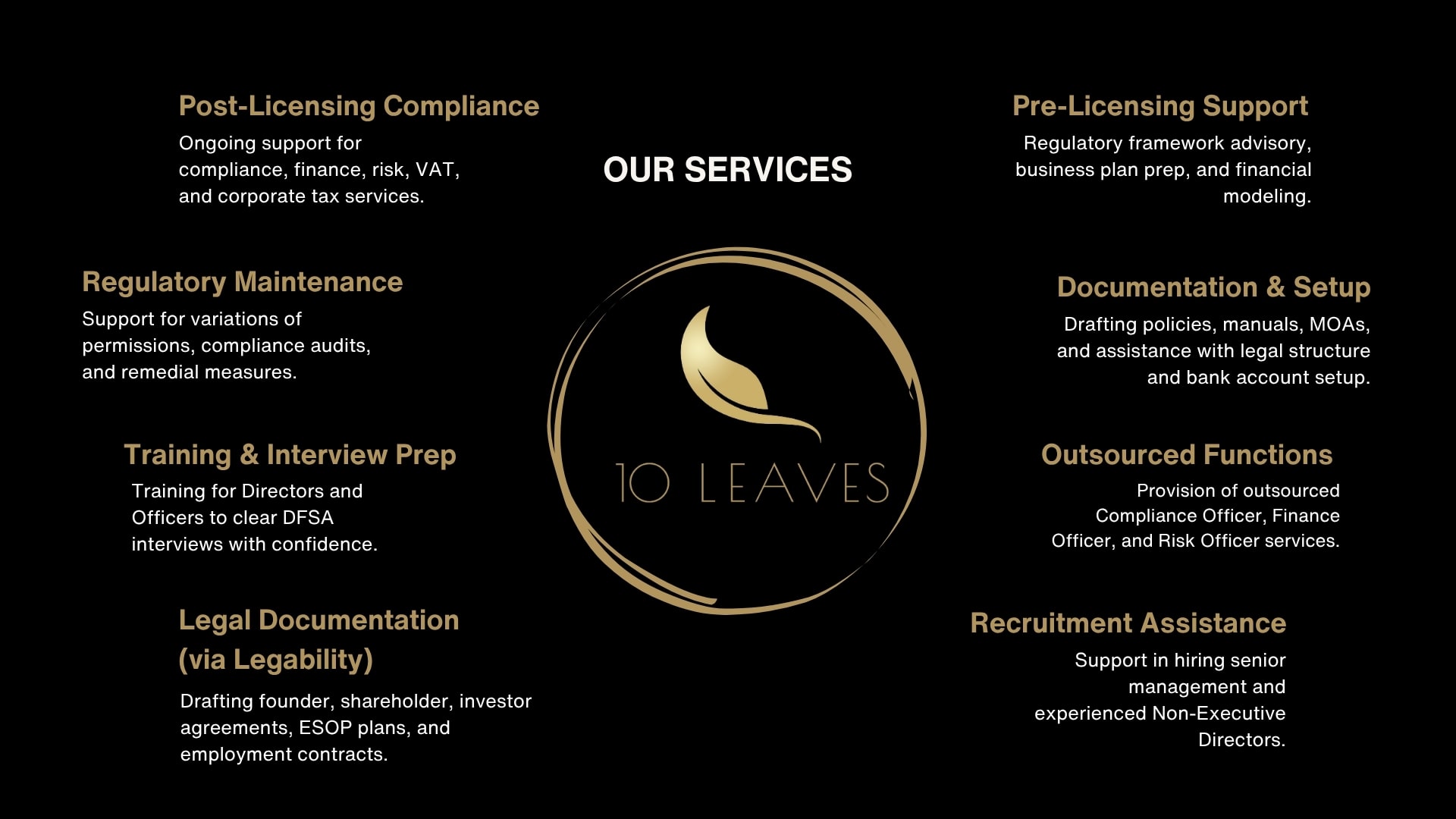
We provide turnkey services for applications in the DIFC. From initial consulting to assistance in authorisations, to assistance in preparation of the legal documentation, 10 Leaves helps you navigate the DFSA Rulebook and submit an application that is comprehensive, complete and compliant.
Our post-authorisation services include compliance, finance and risk outsourcing, company secretarial services and accounting/bookkeeping services. We also engage in VAT and corporate tax reporting as part of the finance function.
Our training arm – 10 Academy, assists members of the Board and the senior management of authorised firms to familiarize themselves with the DFSA and DIFC regulatory framework and with their Continuing Professional Development requirements as set out by the DFSA.
Our services include assistance in:
1. Reviewing the business model and advice on the applicable regulatory framework;
2. Preparation of the Regulatory Business Plan and comprehensive financial projections;
3. Preparation of all policies, processes and manuals required;
4. Provision of Outsourced Compliance Officer, Outsourced Risk Officer and Outsourced Finance Officer services;
5. Provision of Company Secretary and advise on sound Corporate Governance;
6. Finalising the legal structure, including holding company setup and customisation of Memorandums; and
7. Finalisation of leased space, bank account opening and obtaining Financial Services Permissions.
Get in touch today! to know more about DIFC Licensing Categories










 CONTACT